
The Doomed King's Bodyguard:
Warin Edwardessone
The earliest recorded person named Edwardson, Warin served in the famous Cheshire Bodyguard of King Richard II
On the 29th July 1398, a scribe of the English Royal Court made a list of Men-at-Arms on the payroll of the King’s Bodyguard. This was an important task – King Richard II was under threat from many of his own noblemen, having already faced several revolts against his authority. He remained unpopular amongst many – so a strong bodyguard, of unquestioning loyalty, was of the essence. And who would stay loyal without regular pay?
With much of the Kingdom taking against Richard, there were only a few regions in which he could put his faith. Foremost among them was Cheshire, which in effect was Richard’s personal possession. Famously home to ‘war-like’ archers, by 1398 Richard was maintaining a standing bodyguard from the county. The scribe would have noted this as he wrote – there were many men from the Macclesfield Hundred specifically, from places like Astbury, Gawsworth and Wilmslow. And from ‘Altyncham’, he noted, there was a Man-at-Arms, by the name of ‘Warin Edwardessone’.
Warin Edwardsessone (Warren Edwardson, in modern spelling) is the first individual named Edwardson whom we can find, with a high degree of certainty, in the historical record. There he is in the Rolls of Payment from 1398, a man of the Royal entourage no less. His record is searchable on Southampton University's Medieval Soldier Database, to whom we owe our thanks for its discovery.
Having said that, we know next to nothing about him other than what is recorded in this paltry record. To flesh Warin out as an individual, we need to consider the historical context in which we find him.
Richard II had come to power in 1377, aged only 10. At first a council of regents had ruled for him, but following the Peasants’ Revolt of 1381 he had come to the fore in his own right. Unfortunately, he brought an unfaltering self-belief that was not to be born out by experience. From the outset he put noses out of joint – favouring a small number of courtiers and a private military retinue, alienating most of his senior nobles. Worse, despite being the son of Edward the Black Prince, and grandson of Edward III, two famous warrior-leaders, Richard pursued a policy of negotiation with France that aimed to end the ongoing Hundred Years’ War. This stoked ill-feeling and opposition. In 1387 several ‘Lords Appellant’ had wrestled effective control from Richard; he regained most of his power by 1389, but through the 1390s there was an uneasy truce between King and nobles, with little doubt that the contest was not over.
This was an age of private armies, in which Lords could raise independent military forces from the territory which they controlled. Thus Richard could not count on the loyalty of men in counties controlled by Lords who opposed him. But Cheshire was different – it was a ‘County Palatine’, an area ruled personally by a hereditary noblema, enjoying special authority and autonomy from the rest of the kingdom. And Richard II himself was the Earl of Cheshire, meaning that he could raise a military force from the county directly, in his own name. It was therefore no surprise that he chose his personal bodyguard from Cheshire in the 1390s. To further secure their loyalty, he heaped patronage on his chief supporters from the county. This also seems to have bred a surprising familiarity with the King amongst the Cheshire men – they are recorded as referring to him, in person, as ‘Dycum’ (Dick). This may have been satire, but it hints at the jealousy and outrage felt by gentlemen elsewhere, who seethed at such favouritism.
The Cheshire bodyguard acted as Richard’s personal enforcers, wearing his livery badge of the White Hart to starkly identify themselves. Among them were many longbowmen, but Men-at-Arms were also included in the bodyguard – soldiers who were generally a social rank above the archers, being trained in hand-to-hand combat with sword and lance; able to kit themselves out with quality arms and armour; and provide their own horse. Although there may have been a grey area between the two categories, but most Men-at-Arms came from the ranks of lesser gentry and rich yeomen with pretensions to gentility. It was this rank to which Warin Edwardessone likely belonged. The Cheshire men were notorious for their skill as soldiers, honed over many years of war against the Welsh and French. They had a reputation for throwing their weight around, and for getting up to mischief such as raiding neighbouring counties.
As a Man-at-Arms ‘of Altryncham’, we can assume that Warin was of some significant local standing. Altrincham was at the time a small market-town of around 300-500 people, and any local Men-at-Arms would have been well known. He would almost certainly have served the local lordly clan – likely one of the Venables, Massey or Booth families, who were all prominent landowners in the area – and they in turn owed their lands directly to the King. Warin probably held a respectable slice of land locally, in his own name and/or rented from his lord. He must have had the means to outfit himself as a credible warrior – armour, sword and lance, field equipment and at least two horses – costing somewhere between £15 – 30 at the time, roughly £12 – 25,000 today. Warin must therefore have been a man of solid means and local prominence. Not to mention a tough customer - in this era, Men-at-Arms fought on foot as heavy infantry, wielding swords, lances, and pole-arms in the thick of battle while the archers reigned terror from a distance. Anyone putting himself forward as a Man-at-Arms needed to be well-trained and fit, otherwise he would not have lasted long in the gruesome melee of medieval combat.
The records show that he was already being paid a stipend the previous year, in 1397. In the 'Welsh Records: Recognizance Rolls of Chester' the Annual Report of the Deputy Keeper of the Public Records for 3rd Oct 1397 shows a grant to Warin of 2d (pence) a day for life. This equated to about 6 shillings per month, or several hundred pounds in today’s money – a not inconsiderable supplement to a gentleman’s income. And this was paid directly from the King’s Cheshire revenues. So Warin was already a retainer in the Cheshire royal affinity before 1398— part of Richard II’s military network in Cheshire.
Therefore, our earliest named Edwardson was at least bordering on gentlemanly status in the 1390s, and was even in Royal favour. This has wider implications for Edwardson history in the region, which we will shortly investigate in our blog. But having no further details about Warin, what can we say about his likely fate, using the wider historical context?
To (heavily) summarize the story, in 1397 Richard II has exiled his cousin, Henry Bolingbroke, who’s loyalty he mis-trusted. On the death of Bolingbroke’s father, John of Gaunt, in 1399, Richard seized the lands which would have passed to Bolingbroke. He then departed for Ireland with his closest followers, including many of his Cheshire bodyguard – a huge mistake, as an incensed Bolingbroke then returned to England and became the standard bearer for widespread anti-Richard feeling. Without their leader physically present, and with the momentum behind Bolingbroke, there was little that the remaining pro-Richard forces could do to stop him. By the time that Richard belatedly returned in July, he had effectively already lost. He surrendered to Bolingbroke at Flint Castle on 19th August, and was taken into a captivity from which he would never emerge. The next year, Bolingbroke had himself crowned as King Herny IV, and Richard died ‘in mysterious circumstances’ (likely starved to death).
The wider questions of this story – did Bolingbroke always intended to steal the throne? Why did Richard go to Ireland at such a terrible time? – are outside our scope here. We only need to ask – what likely happened to Warin amidst this major reversal?
Well, as Bolingbroke had marched through Cheshire on his was to confront Richard, he had taken a swipe at the King’s favoured county, with many prominent supporters of Richard being killed – for example, Peter Legh, seemingly the most prominent Richard supporter to have remained behind in Cheshire, was summarily beheaded and his head impaled on top of Chester’s Eastgate, where the famous Victorian clock now stands. Any members of the bodyguard left behind in the county, outnumbered and leaderless, likely lied-low. However, once he had secured Richard, the now Henry IV took a more conciliatory tone towards Cheshire. This did not prevent a pro-Richard rising in the county in early 1400 - in which Chester castle was briefly besieged – in which many of Richard’s prominent Cheshire favourites participated. However, that rising was very short lived, with most of its participants ultimately throwing themselves on Henry IV’s mercy (which he generally granted).
Therefore, we are left with a few possible outcomes for Warin. If he accompanied the King to Ireland and back, he may have bee arrested with his master, and likely forced to submit to Bolingbroke. If he remained in Cheshire, he may have been killed by Bolingbroke’s supporters, especially if he was vocal in trying to rouse resistance to them. Or he may have lied-low and waited out the storm, accepting his likely reversal of fortune as Bolingbroke took the throne. After all, the Massys and the Venables, whom Warin may have served, made peace with the newly minted Henry IV. At least until Henry ‘Hotspur’ Percy’s rising of 1403, which sought to mobilise simmering anti-Bolingbroke feeling in Cheshire. If Warin was still alive then, maybe he participated. In the absence of further evidence, we just can’t say. But one hopes that he was canny enough to save both his life and his wealth. There is no telling when he died, but there were other Edwardsons active in the area a few decades later - who they were, whether they were connected to Warin, and what this might tell us, will be investigated in our blog.
Ultimately then, there is little that we can say about Warin unless more evidence emerges. Whether it does or not, his significance to the Edwardson story – as the earliest confirmed Edwardson and a Royal Bodyguard to boot – is surely guaranteed.

Brass monument to a Man-at-Arms from St Mary's parish church, North Leigh, Oxfordshire (1431)

The Westminster Portrait of Richard II, which somehow conveys both the boy King's majesty and his arrogance (1390)

This image from Froissart's 1410 chronicle (showing the Battle of Poitiers, 1356) is a depiction on Men-at-Arms contemporary to Warin's time, showing their almost complete coverage by armour, as well as the lances and swords which they wield
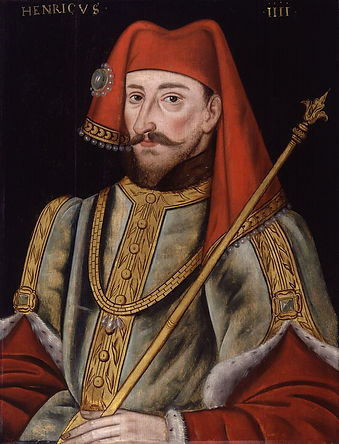
Henry Bolingbroke, later Henry IV, who's victory over his Royal cousin Richard was more categoric than he can have hoped