
The Edwardson Family of Prescot and Widnes, Lancashire
Updated: Feb 28
Non-Conformity, Community, and Religious Networks in the Nineteenth Century
February 2026
By Tanja Arbuthnot
-------------------------------------------------------------------------------------------------------------------------
Geographical Context: Prescot, Penketh, and Widnes
The ancient parish of Prescot was historically extensive, encompassing a number of townships including Penketh and areas that would later become Widnes. In the early nineteenth century, Penketh retained a semi-rural character, while Prescot functioned as a small market and manufacturing town, long associated with watchmaking and artisanal trades.
Widnes, situated to the west along the River Mersey, underwent significant transformation later in the century with the growth of chemical industries and improved transport links, particularly following the opening of the Sankey Canal and later railway connections. These developments led to increased population mobility between Prescot, Penketh, Widnes, and neighbouring parishes such as Farnworth, Winwick, and Great Sankey.
Non-conformist chapels often served dispersed populations across parish boundaries, creating religious communities that were regional rather than strictly parochial.
---------------------------------------------------------------------------------------------------------------------------
My 4th great-grandfather, Thomas Edwardson (1810–1882), was born in Prescot and baptised at the Independent Ebenezer Chapel, New Road, a nonconformist church closely associated with Prescot’s artisan families. Thomas married Ann Critchley in 1833, and over the next two decades, they raised ten children while continuing in the watch trade.
Parish records clearly show that all their children were baptised in the Ebenezer Chapel, New Road. In 1854, Thomas was recorded in the UK, City and Counties Directories, 1766- 1946, as being a “Watchmaker” residing on New Road, the same road as his Chapel. Additionally, England census records spanning from 1841 to his death in 1882 has him living in New Road.
-------------------------------------------------------------------------------------------------------------------------
History of Ebenezer Church, Prescot
Founding and Early Years
Ebenezer Church was founded in 1756 in Prescot, Lancashire and was part of the Independent churches, which emphasized the autonomy of each congregation. In the 19th century, these churches became known as Congregational churches. Significant events in the history of Ebenezer Church in Prescot include its establishment as a Baptist congregation in the early 18th century and its survival through periods of persecution, particularly during the Sacheverell Riots. The church has also played a crucial role in the formation of other Baptist congregations in the surrounding area.
During the period covered by the Edwardson family’s records — late 18th to late 19th century — Ebenezer was an active Independent (Congregational) church, which meant that each congregation was self-governing and autonomous (a hallmark of Congregationalism) and that Ministers were selected by the members rather than appointed by bishops.
Baptisms, marriages, and meetings were recorded in the chapel’s own registers rather than in Anglican parish books and Chapel membership would often indicate a family’s sustained non-conformist affiliation.
According to archived chapel registers, Baptisms at Ebenezer were recorded from 1799 to 1837 on film MFPR 2268 (Manchester City Archives microfilm). The church was located at New Road, Prescot, where Thomas Edwardson lived with his family until his death.
Ebenezer was an Independent (Congregationalist) chapel — part of the broader non-conformist tradition that included Wesleyan Methodists, Primitive Methodists, Baptists, and others. As Independents. Religious services would have emphasised lay preaching, Scripture reading, and congregational governance. The chapel likely held weekly Sunday services, mid-week prayer meetings, and Sunday schools, with baptisms and communion celebrated by consent of the membership rather than clergy appointed by the Church of England. Chapel registers focused on baptisms, confirmations, and local membership rather than parish rates or tithes.
This contrasts with Anglican parish registers, which were mandated by law to record baptisms, marriages, and burials — but not religious affiliation. Independent chapels recorded religious life that Anglican books did not.

Ebenezer Chapel, New Road, Prescot
Thomas’s parents, William Edwardson and Hannah Clitherow were married on 16th January 1808 at St Mary the Virgin, Prescot. Although this was a traditional Anglican church, what can be strongly suggested is that they, or at least William was a non conformist. This is strengthened by the fact that they were married by “Licence” and not Banns.

Lancashire Parish Project Marriage Entry
In many instances, couples that were not married with Banns, meant:
Speed and Convenience: A license (commonly a "Common License") allowed the marriage to take place shortly after application, often within 7 days, rather than waiting for the three Sundays required for banns.
Privacy and Secrecy: Unlike the public reading of banns in church, which
announced intentions to the whole community, a license kept the engagement private.
Social Status: Purchasing a license was considered a symbol of higher status and wealth, often costing between 10 shillings and several pounds.
Flexibility for Minors: If a bride or groom was under 21, a license allowed them to marry with parental or guardian consent.
Avoiding Public Scandal: It was useful if the bride was already pregnant,
allowing for a quieter, faster wedding.
It also indicated the couple were of different parishes.
By Licence, in many instances, also denoted nonconformist / independent religion
While banns were free, licences offered convenience and confidentiality to those who could afford them.
“From 1754 up to 1837 all marriages (with the exception of Quakers and Jews) had to take place in the parish church. Marriages of nonconformists during this period will normally have no indication of their nonconformity, though a marriage by licence could be an indicator of nonconformity.”

Marriage Entry William Edwardson & Hannah Clitherow, Ebenezer Chapel, Prescot
Further evidence of the complexity and flexibility of religious affiliation within the Edwardson family network is provided by Ann Critchley, Thomas’s wife, who was baptised at St Mary’s Church, Rainhill, an Anglican parish church. This Anglican baptism, occurring alongside clear non-conformist associations elsewhere in the family, highlights the extent to which denominational boundaries were often negotiated pragmatically rather than rigidly observed.
---------------------------------------------------------------------------------------------------------------------------
The Edwardson / Critchley Connection and Earlier Roots of Dissent
Thomas Edwardson’s marriage into the Critchley family further situates the Edwardsons within a long-established network of Lancashire dissent. Records associated with the Critchley name — which appears with variant spellings including Critchely, Crouchley, and Critchly — indicate that this family too was closely associated with non-conformist practice in later generations.
Tracing Ann Critchley’s direct paternal line leads back to Thomas Crouchley, who married Jane Rogerson on 30 April 1640 at All Saints’ Church, Wigan, one of the most significant ecclesiastical centres in Lancashire. This marriage represents the earliest securely documented point in the Critchley/Crouchley line and is of particular historical interest due to its timing.
The year 1640 marked the beginning of a period of profound political and religious upheaval in England. Relations between Crown and Parliament were rapidly deteriorating, and disputes over church governance, episcopal authority, and religious conformity were intensifying. Within two years, these tensions would erupt into the English Civil War.
Questions of conscience, worship, and obedience to ecclesiastical authority were already deeply embedded in local communities well before open conflict began.
Although the marriage of Thomas Crouchley and Jane Rogerson took place within the Anglican parish church, this does not preclude later dissenting affiliation. Prior to the Civil War, parish churches remained the primary — and often the only — legally recognised venues for marriage. Many families who would later adopt Presbyterian, Independent, or other dissenting positions appear entirely within Anglican registers during this period.
Wigan’s parish registers, which extend back into the late sixteenth century, are among the most complete in Lancashire. They preserve baptisms, marriages, and burials through the early Stuart period and into the years of civil conflict. The survival and continuity of these records allow families such as the Rogerson’s and Crouchley’s/Critchley’s to be traced across a period when religious identities were in flux and increasingly contested.
By the later seventeenth and eighteenth centuries, descendants of these early parish families begin to appear more clearly within non-conformist contexts. The later emergence of Critchley families among artisan trades and dissenting congregations mirrors a broader Lancashire pattern, in which families rooted in the parish system before the Civil War became prominent supporters of Independent, Methodist, and other non-conformist movements in subsequent generations.
The Edwardson–Critchley marriage therefore represents not merely a union of two artisan families, but the convergence of long-established Lancashire lineages whose religious identities evolved alongside — and were shaped by — the major political and ecclesiastical transformations of early modern England.
Critchely/Critchley/Crouchley families are recorded in Prescot census returns as shoemakers and watch/tool repairers, trades deeply embedded in the town’s artisanal economy. Edwardson families often appear in similar artisan occupations — reinforcing the social milieu around non-conformist chapels, where lay participation and mutual industry networks were strong.
This economic context helps explain why these families gravitated toward independent chapels: literacy, self-help, and mutual support were values shared by both artisan culture and non-conformist religion. This continuity strengthens the interpretation of non-conformity within the Edwardson family as inherited, networked, and historically grounded rather than incidental or isolated.

Ann Edwardson (neé Critchley) and her daughter Mary Ann Edwardson. This photograph was taken after the funeral of her husband Thomas in 1882
In nineteenth-century Lancashire, it was not uncommon for individuals within predominantly non-conformist families to appear in Anglican parish registers. Anglican baptism could reflect geographical convenience, the temporary absence of a local chapel, familial preference, or the desire to ensure formal parish recognition, particularly for children born in areas where the parish church remained the most accessible or administratively established institution.
Such instances do not necessarily indicate a rejection of dissenting beliefs but rather demonstrate how Anglican parishes continued to function as civic as well as religious authorities, even for families whose regular worship took place elsewhere. The baptism of Ann Critchley at St Mary’s, Rainhill, therefore reinforces the interpretation of the Edwardson family’s religious identity as situational and adaptive, embedded within a landscape where Anglican and non-conformist institutions coexisted and overlapped in daily life.
Non-conformity in England did not emerge suddenly, nor was it simply a matter of personal religious preference. It developed from a combination of political authority, religious governance, social change, and regional economic conditions. Lancashire proved fertile ground for dissent. Following the English Reformation, the Church of England became both a religious and political institution, enforcing uniform worship under state authority. Those who objected—whether on theological grounds, governance, or conscience—were labelled Dissenters. Although the Toleration Act of 1689 legalised non-Anglican Protestant worship, it did not grant equality. Dissenters were excluded from universities, public office, and many civic roles well into the nineteenth century. This marginalisation strengthened dissenting identities rather than weakening them.
---------------------------------------------------------------------------------------------------------------------------
Lancashire developed non-conformity earlier and more deeply than many other English counties due to several overlapping factors.
1. Weak Anglican Infrastructure
Large parts of Lancashire were historically under-served by the Church of England. Parishes were vast, clergy were few, and churches were often distant from growing populations. This created space for alternative religious leadership.
Independent preachers, Methodist circuit riders, and lay ministers filled this vacuum—particularly in rapidly expanding townships such as Prescot, Widnes, Bolton, and Manchester.
---------------------------------------------------------------------------------------------------------------------------
2. Industrialisation and Population Movement
From the mid-18th century onward, Lancashire experienced intense industrial growth. Families moved frequently for work, weakening traditional parish loyalties.
Non-conformist chapels were:
quicker to establish
more flexible in governance
embedded within working communities
They offered stability, moral structure, and social support in environments shaped by economic volatility.
-----------------------------------------------------------------------------------------------------------------------
3. Class and Power Dynamics
Anglicanism was closely tied to:
landed elites
local magistracy
tithes and compulsory parish rates
For artisans, tradespeople, and later industrial workers, dissent offered religious independence from elite control. Chapel governance allowed ordinary members to vote, speak, and hold office—an early form of local democracy.
-----------------------------------------------------------------------------------------------------------------------
4. Education and Literacy
Non-conformists strongly promoted literacy, Bible reading, and education. Lancashire dissenting communities established:
Sunday schools
reading societies
mutual improvement groups
This emphasis resonated in industrial areas where formal education lagged behind population growth.
-------------------------------------------------------------------------------------------------------------------------
5. Moral Reform and Mutual Aid
Dissenting chapels provided more than worship. They functioned as:
welfare hubs
employment networks
charitable institutions
---------------------------------------------------------------------------------------------------------------------------
Methodists and Independents emphasised practical Christianity — temperance, charity, and social responsibility—making chapels central to everyday life.
From the late 17th century onward, Prescot became a centre of Nonconformist religious life in south-west Lancashire. Nonconformists were Christians who dissented from the Church of England and worshipped in independent congregations. These communities typically aligned with Presbyterian, Independent/Congregational, Unitarian, or later Methodist beliefs.
The rise of nonconformity in the region was influenced by: - Industrial trades, such as watchmaking and toolmaking, which fostered literacy, independence, and craft guild networks.
Political and religious dissent following the Restoration and Act of Uniformity (1662) and a local culture that valued self-governance and community organisation outside the established church. By the late eighteenth and early nineteenth centuries, Lancashire had become one of the strongest centres of non-conformity in the country. ²
The Ebenezer Chapel was one of the major Independent (later Congregational) chapels in Prescot. Founded in the early 19th century (with roots from earlier dissenting meeting houses), it became a spiritual home for many families who did not attend the Anglican parish church. Major non-conformist groups in the Prescot – Widnes area included:
Independent / Congregationalists
Wesleyan Methodists
Primitive Methodists
Baptists
Unitarians
Quakers
Independent chapels typically operated under Congregational principles, meaning each congregation governed itself without external ecclesiastical control. Such chapels often maintained baptism registers, membership rolls, disciplinary records and minutes of church meetings.
These records were separate from Anglican parish registers and are now largely preserved in collections such as the RG4 series and local archives. ³ The Edwardson family’s appearance in these records rather than parish registers is entirely consistent with Independent practice.
A particularly noteworthy aspect of Thomas Edwardson’s life is that, despite his baptism within the Independent (Congregational) tradition, he and his wife Hannah were both buried in St Mary’s Churchyard, Prescot, an Anglican burial ground. At first glance, this may appear inconsistent with the family’s non-conformist affiliations; however, such arrangements were neither unusual nor contradictory in nineteenth century Lancashire.
Prior to the expansion of municipal cemeteries later in the century, Anglican churchyards remained the principal — and in many cases the only — legally sanctioned burial grounds in many towns and townships. Non-conformist chapels frequently lacked consecrated burial space, particularly in urbanising areas such as Prescot. As a result, dissenters were commonly interred in parish churchyards, often without Anglican rites, or with minimal ecclesiastical involvement.
Furthermore, burial practices were often shaped by family tradition, local custom, and practical considerations rather than strict denominational adherence. In mixed or long-established communities, Anglican churchyards functioned as communal burial spaces serving the entire population, regardless of religious affiliation.
The Edwardsons’ burial at St Mary’s therefore reflects the pragmatic coexistence of non-conformist worship and Anglican civic infrastructure, rather than a reversion to Anglicanism. It underscores the complexity of religious identity in nineteenth-century England, where denominational boundaries in life did not always translate into separation in death.
--------------------------------------------------------------------------------------------------------------------------
Independent, Wesleyan, and Methodist Overlap
Although Thomas Edwardson’s baptism places his immediate family within the Independent tradition, the wider Edwardson family cluster in Prescot appears to have existed within a broader non-conformist milieu. In industrial Lancashire, denominational boundaries were often permeable.
Wesleyan and Methodist chapels proliferated rapidly in the Prescot and Widnes districts during the late eighteenth and early nineteenth centuries. Families frequently attended different chapels over time due to marriage, residence, employment, or chapel closures. It was not uncommon for siblings or cousins to appear in different denominational registers. This suggests that the Edwardsons participated in a shared dissenting culture rather than a narrowly defined sectarian identity.
Across multiple generations, extending back to at least the 1760s, surviving records demonstrate a sustained pattern of non-conformist affiliation within Edwardson family groups. Baptisms, marriages, and burials consistently appear in dissenting registers, indicating long-term participation in Independent, Wesleyan, and Methodist congregations rather than sporadic or incidental non-conformity.
While occasional entries in Anglican parish registers—such as those of Winwick Parish (Winwick, Parish Registers 1756-1806) — do occur, these should be understood within the broader context of record survival, geographical convenience, and legal necessity, rather than as evidence of religious conformity. In the majority of cases, where both parish and non-conformist registers are available, the Edwardson family’s religious life is more clearly and consistently documented within non conformist records.
This enduring pattern suggests that non-conformity was not a transient or individual choice, but a deeply embedded family tradition, transmitted across generations and reinforced through marriage, community networks, and chapel-based social life. The Edwardsons’ long-standing presence within dissenting congregations situates them firmly within Lancashire’s wider non-conformist culture, where religious identity functioned as both a spiritual commitment and a framework for social belonging.
---------------------------------------------------------------------------------------------------------------------------
Daily Life in a Non-Conformist Household
For non-conformist families such as the Edwardsons, chapel life extended far beyond weekly worship. Chapels functioned as centres of religious instruction and preaching; Sunday schools for children; mid-week prayer and study meetings; mutual aid and charitable relief; literacy and moral education.
Education was of particular importance. Many non-conformist chapels operated Sunday schools’ decades before state-supported education became widespread. Literacy was viewed as essential for Bible reading and moral improvement, and this emphasis often resulted in higher literacy rates among dissenting populations. ⁴
---------------------------------------------------------------------------------------------------------------------------
Prescot, Widnes, and Industrial Change
During Thomas Edwardson’s lifetime, the region underwent significant economic change. Prescot’s traditional crafts declined, while Widnes expanded rapidly as an industrial centre later in the century. Thomas and many of the Edwardson branches were and had been very involved within the watchmaking industry. Housing such as Seddons Row reflects the growth of compact working-class residential developments associated with industrial employment.
Non-conformist chapels provided stability amid this transformation, offering social structure and continuity as populations shifted and communities expanded.
---------------------------------------------------------------------------------------------------------------------------
Civic Responsibility and Practical Faith in Industrial Widnes
Thomas Edwardson’s son, also named Thomas Edwardson, gave tangible expression to the family’s religious values through his public actions within the town of Widnes. His prominence and sense of civic responsibility are particularly evident in an episode recorded by the local press in 1885, during a period of severe depression in the chemical industry that resulted in widespread unemployment and hardship among working families.
At this time, the Widnes newspaper reported that Thomas Edwardson arranged for the distribution of one hundred loaves of bread accompanied by cheese to men who had been thrown out of work as a consequence of the industrial downturn. Such acts of relief were not insignificant gestures but formed an important part of informal welfare provision in towns where statutory support was limited.
This intervention reflects both the economic fragility of Widnes during the late nineteenth century and Edwardson’s standing as a respected and socially engaged employer.
Moreover, it aligns closely with non-conformist ideals of practical Christianity, which emphasised personal responsibility, charity, and direct action within the community. The episode provides a rare and valuable insight into how religious belief could be translated into concrete social support in an industrial setting.
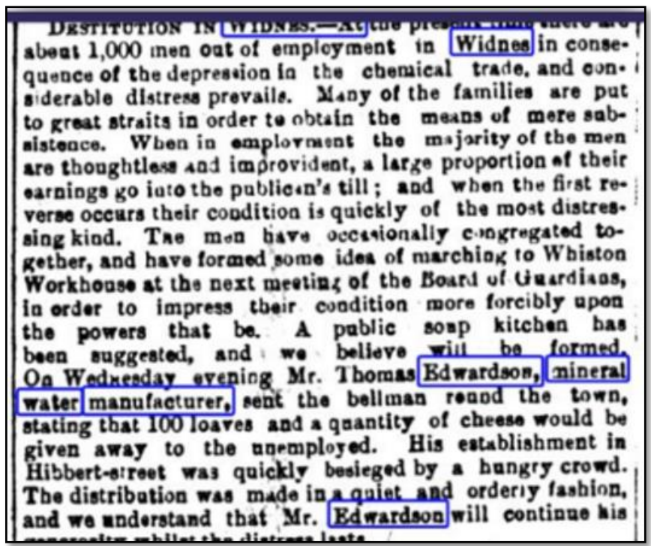
“The distribution was made in a quiet and orderly fashion,
and we understand that Mr. Edwardson will continue with his
generosity whilst the distress lasts.” (Widnes Examiner, 10
October 1885)
A notable feature of the Independent (Congregational) tradition represented by Ebenezer Chapel, New Road, Prescot, was its strong Welsh connection, extending across North Wales, Cheshire, and south Lancashire. Throughout the late eighteenth and nineteenth centuries, significant numbers of Welsh migrants—many from Denbighshire, Flintshire, and the Wrexham area—settled in industrial and market towns such as Prescot, Widnes, St Helens, and Liverpool. These migrants often brought with them a deeply rooted tradition of non-conformist worship, particularly within Presbyterian and Independent denominations.
Ebenezer Chapel stood firmly within this wider Welsh-influenced dissenting network, sharing theological outlooks, preaching styles, and congregational practices that emphasised lay participation, moral discipline, and congregational autonomy. Welsh surnames appear frequently within Independent and Methodist chapel records in the region, reflecting both migration patterns and enduring cultural ties.
In this context, Ebenezer functioned not merely as a local Prescot chapel, but as part of a broader trans-regional non-conformist culture linking Welsh religious life with the expanding industrial communities of Cheshire and Lancashire. Within this context, the Edwardson family’s association with Ebenezer Chapel, Prescot, may be understood as part of a broader trans-regional network of dissenting practice and influence.

St Helens Examiner, St Helens, Lancashire
28 February 1891
Evidence of sustained non-conformist continuity persists into the twentieth century. Many Edwardson descendants in Widnes remained active within dissenting congregations, particularly the Methodist Church. For example, Walter Edwardson (1907–1991) — a second cousin thrice removed — married Agnes Horricks in 1934, and both were lifelong members of the Methodist Church in Widnes. Their enduring affiliation illustrates the persistence of non-conformist religious identity within the Edwardson family across multiple generations and geographical settings.

Runcorn Weekly News, Runcorn, Cheshire,
England
New Methodist Hall, Laburnum Grove
10 October 1963
One distant relative (3rd cousin x 5 removed), James Edwardson (1875–1950) was a member of the Widnes Frederick Street Methodist Church, and he and his wife played a strong role both within the church and the wider community. He was elected to the Widnes Borough Council in 1910 and later served as Mayor of Widnes in 1930 and subsequently held the office of Alderman.

Frederick Street Methodist Church.
Supplied by Brian Fisher
A chapel was opened in 1880 at Prince’s Street, and a new chapel was rebuilt in 1905 at Frederick Street, Simms Cross. It closed in 1992 and the building has since been demolished.
Throughout his civic career, Alderman James Edwardson, played a leading role on both the Education Committee and the Library Committee, contributing significantly to the cultural and educational development of the borough.
The Primitive Methodist School on Frederick Street played a central role in the religious and social life of the local non-conformist community.
It provided education not only for the children of church members but also for families associated with other dissenting congregations, reflecting the cooperative ethos that characterised non-conformist life in the district.
Beyond formal education, the Primitive Methodist Young People’s Society of Christian Endeavour functioned as an important social and moral institution. Its members organised regular social gatherings, church readings, and Bible study groups, and were actively engaged in wider community initiatives. Through these activities, the Society fostered religious instruction, social cohesion, and civic responsibility, reinforcing the role of non-conformist institutions as both spiritual centres and vital community hubs.

Warrington Examiner, 1 July 1899
Primitive Methodism gave people a sense of self-worth and a desire for self improvement. Chapels provided education and an opportunity to develop skills in public speaking and leadership. It also provided an alternative way of life, based on moral values, which helped raise families out of poverty.
Also known as ‘Ranters’, for their enthusiastic preaching, ‘Primitive’ Methodists were so called because they wanted a return to an earlier, purer form of Methodism, as founded by John Wesley, based on the early church. In 1932 Primitive Methodists joined with Wesleyan and United Methodists to form the Methodist Church, which continues to promote faith and justice in contemporary society.

Runcorn Weekly News, Runcorn, Cheshire
6 November 1936
Frederick Street Methodist Church
Widnes has had a substantial number of non-Anglican places of worship, reflecting its industrial growth and the strong history of dissenting religion in the area. These include historic and current Methodist chapels, as well as other non-conformist congregations.
Historic Methodist Chapels (19th–20th century)
(Recorded in local archives and church lists)
1. Frederick Street Primitive Methodist – Founded 1880 (demolished c.1980)
2. Moss Bank Chapel (Widnes Dock Chapel) – Founded 1862
3. Victoria Road Wesleyan Methodist – Founded 1864 (closed before 1957)
4. Albert Road Wesleyan Methodist – Founded 1874 (closed 1901)
5. The Tabernacle (Iron chapel) – Founded c.1896 (closed c.1955)
6. Trinity Methodist & URC (formerly Wesley Church) – Founded 1905 (survives as joint Methodist/United Reformed congregation)
These historic chapels attest to a strong Methodist presence in the industrial era, with multiple congregations serving local mining, chemical, and artisan communities.
Methodism — including Primitive, Wesleyan, and later United Reformed affiliations — played a major role in Widnes religious life, especially during the late 19th and early 20th centuries. The proliferation of chapels reflects strong working-class engagement, Sunday schools, and community organisations typical of industrial towns.
Ebenezer Chapel was rebuilt in the 1930s but was eventually demolished around 1970. In 1972, many Congregational churches, including some in the area, merged with the English Presbyterian Church to form the United Reformed Church. However, some congregations chose to remain independent and joined the Congregational Federation.
Conclusion
Within the Edwardson lineage, repeated intermarriage with families bearing the surnames Lucas, Lawrenson, Molyneux, Hill, and Hunt reinforces a sustained pattern of non-conformist affiliation. Baptism, marriage, and burial records associated with these families frequently appear in dissenting registers rather than Anglican parish books, indicating long-term participation in non-conformist religious life. A significant proportion of these associated families are documented within Wesleyan Methodist records, further demonstrating that the Edwardsons were embedded within a broad network of interconnected dissenting households.
These intermarriage patterns are characteristic of non-conformist communities, in which chapel affiliation shaped social networks, marital choices, and patterns of settlement. Religious identity was reinforced not only through belief and worship, but through kinship ties and shared participation in chapel life.
Non-conformity within the Edwardson family was therefore neither isolated nor incidental, but part of a wider religious ecosystem spanning multiple families, denominations, and generations.
The Edwardson family, together with the interconnected artisan families of Prescot, exemplifies the experience of many Lancashire non-conformist households in the nineteenth century. Through the baptism, occupation, and community life of Thomas Edwardson, it is possible to trace the religious, social, and geographical networks that shaped daily life in Prescot, Penketh, and Widnes.
The family’s long-standing affiliation with Independent worship situates them firmly within a dissenting tradition that valued education, community responsibility, and congregational autonomy — hallmarks of Lancashire’s non-conformist heritage.
Footnotes
1. RG4 1148, Ebenezer Chapel, New Road, Prescot; baptism of Thomas Edwardson, 9 September 1810.
2. Watts, Michael R., The Dissenters, Volume II: The Expansion of Evangelical Nonconformity, Oxford University Press.
3. The National Archives, RG4: Registers of Births, Marriages, and Deaths of Protestant Dissenters and Non-Parochial Registers.
4. Snell, K.D.M., Annals of the Labouring Poor, Cambridge University Press.
Sources
Ancestry/FindmyPast/FamilySearch
• Birth Marriage & Death records
• Newspaper articles
• Census records
• Electoral roles
• Trade Directories
• Family stories
Facebook Group: Widnes Past & Present / Halton Heritage
Lancashire Parish Organisation:
My Primitive Methodists:
https://www.myprimitivemethodists.org.uk/content/subjects-2/primitive-methodist history/what-is-primitive-methodism
Internet
• General background information


Comments